Urinalysis has long been a fundamental diagnostic tool. In critical care, however, speed and precision are as important as accuracy. Urine turbidity, the cloudiness of urine, may indicate infection, hematuria, or early kidney dysfunction. Traditionally, this has often been assessed visually. Ana Medica changes that approach through non-contact nephelometry.
Why Urine Turbidity Matters
Urine turbidity is caused by particles suspended in urine, including:
- White and red blood cells, which may indicate infection or hematuria
• Crystals, which may be associated with kidney stones or metabolic disorders
• Bacteria and mucus, which may be associated with urinary tract infections
Laboratory testing provides detailed analysis, but in critical care, delayed results can limit early intervention. ICU teams need real-time signals that help identify deterioration before it becomes clinically severe.
How Nephelometry Works in Urine Monitoring
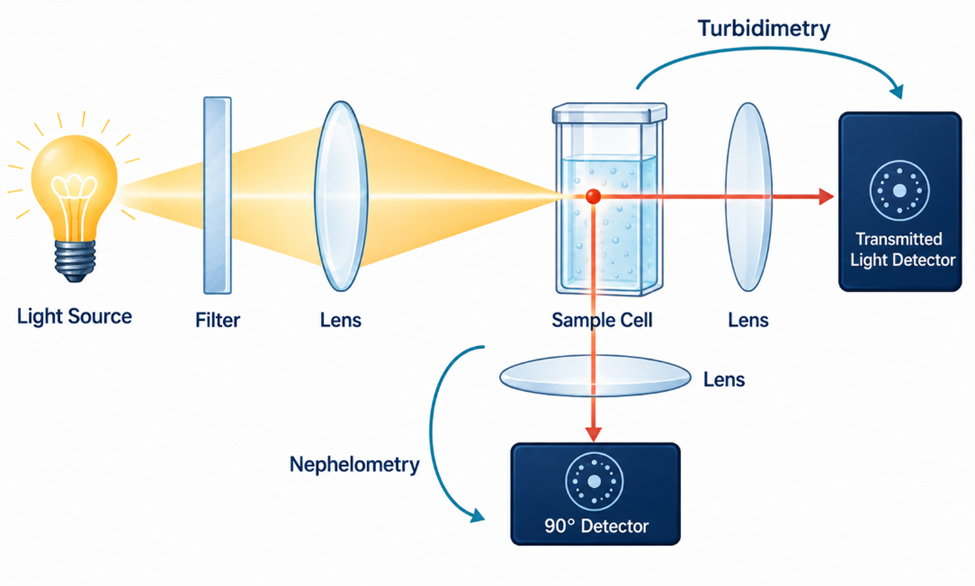
Nephelometry measures how particles scatter light. In Ana Medica, a 90° laser scattering system measures urine turbidity as NTU, or Nephelometric Turbidity Units, while urine passes through a sterile chamber.
Key benefits include:
- Contact-free analysis, reducing manual handling
• Precision with a ±2% error rate
• Immediate detection of turbidity spikes, such as a possible onset of hematuria
• Continuous trending instead of isolated one-time measurements
Real Clinical Applications
Nephelometric turbidity monitoring can support ICU teams in:
- Detecting abnormal urine changes that may be associated with UTIs or catheter-associated urinary tract infections
• Monitoring patients at risk of kidney injury, including septic or oncology patients
• Assessing response after interventions such as diuretic administration
• Screening high-risk groups, including patients with AKI, sepsis, or chemotherapy-related complications
When paired with AI-based logic, turbidity data can also support predictive diagnostics by identifying abnormal patterns earlier and more consistently than manual observation alone.
Why It Belongs in the ICU
ICUs require fast, quantifiable, and low-touch data. Traditional turbidity assessment is often too manual, too subjective, or too delayed to support rapid clinical decision-making. Ana Medica makes turbidity monitoring automatic and actionable, adding diagnostic value without disrupting ICU workflow.
Conclusion
With Ana Medica, urine turbidity is no longer a subjective visual estimate. It becomes a clean, continuous, and clinically meaningful data stream. By using nephelometry, Ana Medica gives healthcare teams another real-time signal that may support earlier intervention and better outcomes for high-risk patients.